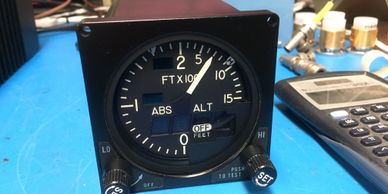
MBT Electronics offers Repair and Overhaul Service for the RT-1115/APN-209 Radar Altimeter System.
- APN-209 Family History
- Reinstalling APN-209 Radar Altimeter After Maintenance
- AN/APN-194 Radar Altimeter System
- AN/ASN-128 Doppler Radar System
MBT Electronics specializes in servicing components of the APN-209 radar altimeter system. This equipment has been installed in Army helicopters since the late 1970s. It is a self contained, panel mounted instrument with the display and receiver-transmitter contained in one unit. There is an optional remote (co-pilots) display which repeats the output of the master unit. Several remote instruments can be installed in a system if necessary.
The APN-209 system is a pulse type radar altimeter utilizing two antennas for the transmit and receive functions. It transmits a short pulse and receives the reflected signal while the tracking system measures the time delay. The aircraft antennas point straight down and the signal bounces off the ground under the aircraft. The time delay is converted to a digital and analog readout in feet. Depending on the height above ground and the received signal level, the tracking circuitry controls the transmit power, pulse width, and receiver sensitivity. It will maintain the correct power and gain for reliable operation over all types of terrain. When the signal is reliable, the off flag pulls out of view and the digital display is enabled.
A problem with all radar altimeters is the tendency to lock-on to stray signals. If a signal is reflected from one antenna directly to the other without bouncing off the ground, the tracking system may be fooled. Usually this results in a constant reading of zero feet. The skids or other items under a helicopter can reflect the signal directly from one antenna to the other. The APN-209 has extensive circuitry to prevent this problem. This equipment was designed for helicopters. Internal adjustments can be customized to compensate for situations such as external (sling) loads or poor installation.
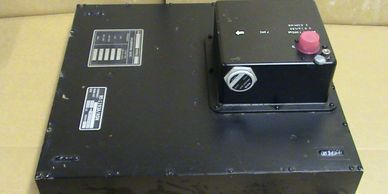
RT-1115C/APN-209 & JG1209AC01
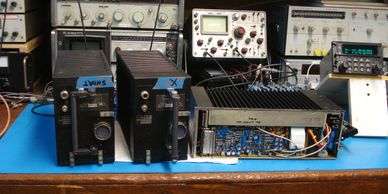
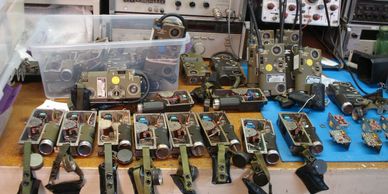
Components on test bench.
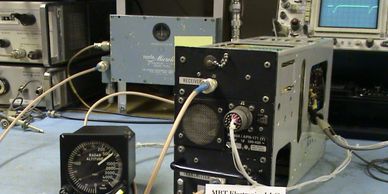
These can be repaired.
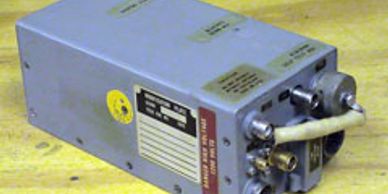
Fabricated installation wiring. Ready to install.
MBT Electronics Offers the Following Services
- Bench test and evaluate
- Written teardown report
- Test data sheet
- Repair
- Overhaul and refinishing
- Upgrade red LED display to green LED display
- Build up good units from junk or de-militarized units
- Rental of working units
- Troubleshooting assistance
- Fabricate wiring harness
- Supply antennas and RF cables
- Buy and sell units
APN-209 Family History
The following information is not from official sources. It is observations and experience that I have collected while repairing APN-209 units. Many different part numbers have been assigned to these units. It is confusing. I have grouped them according to the RT number suffix which they resemble.
All the APN-209 units are interchangeable in the aircraft and will provide similar performance. The difference is the internal technology which has changed greatly over the 30 year existence of this equipment. The early units contain a vacuum tube and the latest units have micro-processor circuitry.
Detailed breakdown of part numbers:
Straight (No Suffix)
- RT-1115/APN-209
- SM-C-707653
- HG7209AA01
- 5841-01-058-7873
The “straight” model seems to be the earliest example of APN-209 and dates from about 1975. It can be identified by the gold coax connector on the back. One connector is gold and one is steel. This model incorporates a vacuum tube transmitter and requires a warm up period when first turned on. The LED display and lighting is red.
A Suffix
- RT-1115A/APN-209
- SM-C-967122
- 5841-01-096-8673
The A model has a solid state transmitter and turns on instantly. The receiver AGC, transmit power control, and pulse width control circuits have been improved. The LED display and lighting is red.
B Suffix
- RT-1115B/APN-209
- SM-C-967283
- 5841-01-140-0941
The B model is similar to the A model except it is night vision compatible. Most units have a green LED display and the High and Low warning lamps are blue / green. This makes the unit more compatible with NVIG (night vision) equipment. Strangely, some units also have red instrument lamps. NVIG lamps are available to replace these red bulbs if required.
C Suffix
- RT-1115C/APN-209
- SM-C-967292
- HG7209AB04
- HG7209AB03
- 5841-01-245-9090
- 5841-01-305-6081
The C model is similar to the B model in form and function. These units date from about 1982. The LED display and lighting is green. There are circuitry improvements including a change in the analog pointer servo system to give better resolution. The servo motor gives off an audible tone when the unit is turned on in a quiet environment.
Note: In the A, B, and C models, the power supply runs very hot and requires some airflow around the instrument case. In some failed units, the solder has melted on the power supply board. For best reliability, be sure that the aircraft installation provides sufficient airflow.
D Suffix
- RT-1115D/APN-209
- A3060585
- HG7209AC01
- 5841-01-245-9091
The D model is completely redesigned internally. These date from about 1993. They can be identified by the position of the analog and digital “zero” trimpot openings on the sides of the unit. The D unit has one opening on the side and one on the top. The previous models have both openings on the side. Otherwise the form and function is the same as the earlier units. They have slightly better performance on the bench than the older models and I suspect that they work a little better in the aircraft. There are noticeable improvements in the transmitter power control and the receiver AGC. The heat problem of the earlier units has been solved and these units are very reliable. The display section has been redesigned for NVIG operations. The lighting is very carefully isolated with rubber boots and green filters. In my opinion this is the best model of the APN-209.
J Suffix
- RT-1115J/APN-209
- HG7209AD01
- HG7209AD02
- SM-C-967283
- 5841-01-421-4162
The J model is a completely new design internally. This is the current model, as far as I know. It has a bare metal case which makes it easy to recognize. The internal construction consists of multi-layer circuit boards with surface mount components. It incorporates micro-processor controllers with proprietary software installed. This model has a verbal warning system. When wired into the aircraft audio system, a voice will sound off when the “Low” or “High” lights come on. This unit runs cool and the power drain is lower than the previous units.
In my opinion, this unit seems to be less robust than the earlier units. The electronic components are very vulnerable to ESD damage. The circuit cards, with tiny gauge circuit runs, are easily damaged when any short circuit occurs, whether inside or outside of the instrument. This damage is difficult to repair when the burned run is deep inside a multilayer board. The micro-controllers are easily destroyed by stray voltages or accidental shorts which may exist in the aircraft installation. Extreme care should be exercised to check for shorts or stray voltages on the connectors in the aircraft before plugging the unit in.
Remotely Mounted RT Units
These units contain the receiver-transmitter section of the APN-209 without the instrument section. They are compatible with any of the ID-1917/APN-209 remote indicators. Any number of remote indicators can be connected in a daisy chain fashion. The case is designed to mount in a remote location in the aircraft and thereby simplify the installation. The unit is controlled by the ID-1917 instrument on/off switch and push-to-test switch. The antennas and electrical connections are identical to the APN-209 units.

- RT-1411/APN-209
- SM-C-967310
- 5841-01-140-1700
- RT-1411A/APN-209
- A3060588
- 5841-01-245-9094
- RT-1411B/APN-209
- HG7209AC01
- 5841-01-421-4161
Remote Indicators
The remote indicators are all compatible electrically and work with any model of the APN-209. The difference is the internal design and the NVIG lighting.
- ID-1917/APN-209
- SM-C-707893
- 5841-01-058-7994
This is the earliest version of the remote indicator. Normally it would be installed in the co-pilots position. It repeats the information from the RT unit. In the aircraft, it looks the same as the RT unit and can control the on-off and test functions. It has its own “high” and “low” bugs and dimming system. This version has a red LED display and lighting.
- ID-1917A/APN-209
- SM-C-967240
- 5841-01-137-8445
Remote indicator similar to “straight” model but probably incorporates subtle improvements.
- JG1209AB04
- JG1209AB02
Remote indicator similar to the ID-1917 units. This model has green LED display and lighting and normally would be used with the B or C model RT units.
- JG1209AC01
This remote indicator is completely redesigned internally. It uses more modern components and incorporates better NVIG design. It is used with the D or J model RT units.

- ID-1917C/APN-209
- A3060591
- 5841-01-245-9093
This remote indicator is similar to the JG1209AC01 and is used with the D or J models.
Antennas
- AS-2595/APN-194
- LG81J1
- 5841-00-181-0330
Antenna. This antenna mounts in a round hole and has a pyramid structure.

- AS-3831/APN-209
- LG81AT01
- SM-D-967308
Antenna. This antenna mounts in a round hole or flat on a surface and has a flat (micro-strip) construction. The diameter is about 6 inches.

- LG81AT2
Antenna. This antenna is a flat (micro-strip) antenna and mounts flat on a surface. The shape is square.
Can other antenna types be used?
All radar altimeters operate at 4.3 Ghz and have similar requirements for antenna performance. The APN-209 radar altimeter will electrically match, and function with, any 4.3 Ghz radar altimeter antenna. Any good quality antenna should work with the APN-209 system but for optimum performance, other factors should be considered.
The beam shape and gain is different with different types of antennas and should be selected to match the type and mission of the aircraft. Some aircraft missions involve roll and pitch maneuvers and would work best with a wide beam antenna. Other missions will do better with a narrow beam antenna.
Another factor is the style of mounting the antenna. The pyramid shaped antennas require a large reinforced hole in the aircraft while the flat micro-strip style can be installed on the skin with a simple backing plate and minimal structural changes.
If a previous system was installed in an aircraft, and it worked well, that antenna installation should work with the APN-209 system. The safest procedure is to use the type of antenna and the mounting location which is successful in another of the same type of aircraft.
The APN-209 system has no installation manual available. Refer to the manuals for other high quality radar altimeters such as Collins and King for information on antenna installation. The suggested location and spacing of antennas will be applicable to the APN-209 system.
Reinstalling APN-209 Radar Altimeter After Maintenance
Two adjustment ports are available on the side of the APN-209 unit. These are small “doors” that slide open to allow access to screwdriver adjustments. These should be adjusted before putting the system back in service.
If these are not adjusted, the radar altimeter will indicate a height above ground when the aircraft is actually on the ground. This represents the electrical delay in the coax cables and the distance from the antennas to the ground. This can be as much as 50 feet in some aircraft.
The two adjustments are independent. One adjustment controls the analog pointer and the other controls the digital readout. Unfortunately the adjustment ports, on the sides of the unit, are hard to reach in a typical aircraft installation. Before installation, the unit can be plugged in to the aircraft connectors and held in the hand while adjusting the trimpots. This also makes it easier for the technician to see the dial while doing the adjustment.
The analog dial is adjusted to read zero. In most units, the dial will hit a mechanical stop just past zero, so be sure that it is not adjusted on the negative side of zero and against the stop.
The digital zero control will adjust the readout to zero and a negative sign will appear if it is adjusted too far. The numbers that would represent the negative direction will not appear. If you see a negative sign, you don’t know how far on the negative side the adjustment actually is. For this reason it is best to adjust it for 1 foot or ticking between 1 and zero. This will insure that it is not adjusted past zero.
If the reading is unstable, it might mean that the ground under the aircraft has poor RF reflective properties. You can wet the ground under the aircraft to get around this problem.
After adjustment, the digital and analog readouts should agree. To test the system, hold a sheet of metal under the antennas at an angle which causes the signal to reflect against a nearby car or other object. The altimeter will indicate a distance to this object.
MBT Electronics Offers Repair / Overhaul Service for the AN/APN-194 Radar Altimeter System.
The APN-194 radar altimeter system consists of a remotely mounted RT (receiver-transmitter), two antennas, and one or more indicators. This system has been installed in numerous aircraft, mostly large turbine types, since about 1974.
This is a pulse type radar altimeter which utilizes solid state electronics except for the transmitter which is a vacuum tube cavity oscillator. The output power is 200 watts peak. Due to the ample transmit power; the performance of the system is very good. The maximum range is 5000 feet and the system will read down to zero feet.
There are several compatible indicators available for this system which is detailed below. The difference between the indicators is mainly the scale factors and zero position. Some have zero at the top, and some have zero at the bottom. One indicator has a 1000 foot range with an expanded scale. The indicators which were used with the older AN/APN-141 radar altimeter system are also compatible.
The output of the RT unit is an analog DC voltage which the indicator converts into a pointer position. The analog voltage is electrically expanded below 400 feet by circuitry in the RT unit. The indicators have a scale which is also expanded below 400 feet. The pointer drive is a servo which is not affected by aircraft attitude or G force. The indicator servo receives a reference voltage, along with the analog range voltage, from the RT unit. This improves the accuracy of the system because the indicator does not contain a precision voltage reference which could go out of tolerance. The indicator performs a “ratio” measurement comparing the analog range voltage to the reference voltage. The indicator does not need to be calibrated with a specific RT unit. A low altitude warning lamp, controlled by a moveable pointer or “bug”, and a test function are also provided.
The aircraft 115 VAC / 400 cycle power is supplied to the indicator which has its own internal power supply. The on / off switch on the indicator also controls the power to the RT unit. With this design, the indicator has independent operating voltages and will not cause a load on the RT power supply. A failure in the indicator will not damage the RT unit.
An optional digital output module is used in the RT-1015 configuration of the APN-194. This outputs a digital form of the altitude data in addition to the analog outputs.
RT Unit Part Numbers
- RT-1015/APN-194
- HG7194A1
- HG7194A3
- 5841-00-168-7813
- 5841-00-110-8125
Receiver transmitter with digital module installed.
- RT-1042/APN-194
- HG7194A2
- HG7194A4
- 5841-00-165-3030
- 5841-00-110-6262
Receiver transmitter (most common configuration)
Remote Indicator Part Numbers
- ID-1760/APN-194
- JG1061AA01
- 5841-00-168-7812
- ID-1760A/APN-194
- JG1061AB01
- 5841-00-110-4883
- ID-1760B/APN-194
- JG1061CC01
Indicator. Zero at bottom. 5000 foot scale.
- ID-1768/APN-194
- JG1073AA01
- 5841-00-168-7811
- ID-1768A/APN-194
- JG1073AB01
- 5841-00-110-4912
- ID-1068B/APN-194
- JG1073CC01
- 5841-01-087-7951
Indicator. Zero at top. 5000 foot scale.
- ID-1811/APN-194
- JG1082AA01
- 5841-00-110-4130
- ID-1811A/APN-194
- JG1082CC01
- 5841-01-082-1744
Indicator. Zero at bottom. 5000 foot scale.
- ID-1879/APN-194
- JG1061AB02
Indicator. Zero at bottom. 5000 foot scale.
- ID-2206/APN-194
- JG1091CC01
- ID-2206A/APN-194
- JG1091DD01
- 5841-01-232-3104
Indicator. Zero at bottom. 1000 foot scale.
Antenna Part Numbers
- AS-2595/APN-194
- LG91J1
- 5841-00-181-0330
MBT Electronics offers the following services:
- Bench test and evaluate
- Written tear down report
- Test data sheet
- Repair
- Overhaul and refinishing
- Build up good units from junk or de-militarized components
- Rental of working units
- Troubleshooting assistance
- Buy and sell parts and units
components of APN 194 on test bench.
Repair Service for AN/ASN-128 and AN/ASN-128A Doppler Radar System Components
The ASN-128 is a navigation system designed for military helicopters. In the age before GPS, cross-country navigation of a helicopter, in military situations, was difficult. Most forms of electronic air navigation involved receiving a line-of-sight signal and required the pilot to do plotting and calculation. The pilot of a low flying helicopter has no time for plotting and the signals from navigation stations are unreliable at low flight levels. In military situations, external navigation signals may be disrupted. The solution requires a self contained, automatic, system that will calculate the present position of the aircraft, in real time, and display navigation information to the pilot.
The ASN-128 uses Doppler radar as its primary sensor. The movement of the aircraft across the earth is detected by four microwave beams which are radiated from the antenna and reflect back from the ground. The beams radiate out in four directions and reflect back from the ground with a slightly altered frequency, do to the relative movement of the aircraft. The right front, left front, right rear, and left rear beams strike the earth under the helicopter at an angle which causes a change in the frequency of the reflecting energy if the aircraft is moving. The physical laws of the Doppler-effect relate the actual change in frequency to the velocity of the aircraft. Thus the true velocity of the aircraft across the earth can be known regardless of wind speed and direction.
The four beams are periodically sampled, one at a time, and analyzed for frequency shift. When flying normally, the two forward beams will show an increase in frequency and the two aft beams will show a decrease. If sideways or even rearward movement exists, the frequency shift of the beams will tell the story. The computer combines this information with other information available in the aircraft system.
The other inputs utilized include: heading, pitch, roll, and true air speed. These are available, in most aircraft, from the air data computer and heading reference systems. The computer in the ASN-128 system combines these inputs with the analysis of the four beams and derives a complete navigation picture. The pilot only has to select which function is required and fly the helicopter.
The ASN-128 is a dead-reckoning system because it has no absolute knowledge of position. The initial position must be entered before flight. The relative movement of the aircraft is then maintained within the accuracy tolerance of the system.
The ASN-128 system is organized in three units. The Computer Display Unit is located in the cockpit and contains the computation and display circuitry. The pilot controls the mode of operation and reads the information from this unit.
The Signal Data Converter is a remotely mounted black box containing auxiliary circuitry including: the power supply, the Doppler frequency tracking circuitry, and the synchro to digital converter. The inputs from the aircraft systems, in synchro form, are converted to digital form in this unit.
The Receiver-Transmitter-Antenna unit contains the RF circuitry including: the transmitter, the receiver, the beam switching system, the video amplifier, and the calibration factors memory. The large flat area on the bottom is the radome and is mounted flush with the belly of the aircraft. The four beams radiate from this surface.
The Computer Display Unit Part Numbers
- CP-1252/ASN-128
- SM-D-858970
- 5841-01-063-1918
- CP-1252B/ASN-128
The Signal Data Converter Part Numbers
- CV-3338/ASN-128
- SM-D-858425
- 5895-01-064-1841
The Signal Data Converter is installed in the avionics compartment of the aircraft. This is a sturdy unit that can stand a lot of abuse. The most likely problem would be from leaking water dripping on the unit and causing corrosion.
The Receiver Transmitter Antenna Part Numbers
- RT-1193/ASN-128
- SM-D-858489
- 5841-01-063-1919
- RT-1193A/ASN-128
- SM-D-858489-2
- 5841-01-318-0654
- SM-D-859104 (Antenna unit without RT components)
The Receiver Transmitter Antenna unit is the most likely component of the ASN-128 system to require maintenance. It is subjected to water, oil and dirt contamination on the bottom of the aircraft. The radome surface is a soft rubber-like coating and is easily damaged.
The Receiver Transmitter circuitry is housed in a dog house on top of the antenna. Although it is sealed, water often enters and causes corrosion of the components. The opposite problem exists when oil from leaking helicopter systems intrudes. These fluids cause the paint and radome coating to deteriorate and peel off.
The radome coating is peeling due to being soaked with oil or hydraulic fluid.
The top of the same antenna. The receiver transmitter components have been removed. The deteriorated paint and radome finish will be removed and the antenna will be refinished.
After refinishing, the Receiver Transmitter Antenna will look much better.
Waveguide Switch Unit Part Numbers
- SM-A-858393
- MD-25K27
- 5985-01-140-1167
This module can be tested, evaluated, and repaired. Corrosion is the usual problem.
Receiver Module Part Numbers
- SM-A-858394
- 5841-01-140-1194
This module can be tested and evaluated. Unfortunately, this is a sealed unit which must be replaced if it becomes inoperative. Like all radar receivers, the sensitive mixer diodes lose efficiency after many hours of operation. This can cause poor performance of the system.
Gunn Diode Oscillator Part Numbers
- SM-A-858395
- 5895-01-117-6488
This module can be tested, evaluated, and repaired.
MBT Offers the following services
Transmitter-Receiver-Antenna
- Bench testing and evaluation
- Written teardown report
- Test data sheet
- Corrosion removal and preservation
- Refinishing, including radome surface.
- Repair by replacing defective modules
- Testing and evaluation of modules
- Repair of modules (if feasible)
- Internal inspection of waveguide and radome
- Electrical testing of the antenna characteristics.
Signal Data Converter
- Bench test
- Written teardown report
- Test data sheet
- Corrosion removal and preservation
- Refinishing
- Repair by replacing defective modules
- Repair of modules (if feasible)
Computer Display Unit
- Bench test and evaluation
- Limited minor repair
Repairing Military Avionics Equipment
MBT electronics is FAA approved repair station # QYMR098B. This means that the shop is approved, by the FAA, to repair components that are itemized on a capability list. The capability list details the part numbers of items that the shop is authorized to repair. When the item is repaired, a tag is attached which certifies that the item has been repaired by an approved facility. The most common tag is the form 8130-3 which is issued by the FAA. This form is basically a formalized serviceable tag, which the repair station fills out, with some details of the repair, and the chief inspector signs. The form tells anyone receiving the part about the repair and who did it. Generally, a tag is necessary for a component to be installed in a certificated aircraft. The installer determines the legitimacy of the tag and the component.
At different times and in different places, the FAA has either allowed or not allowed repair stations to place 8130-3 tags on military avionics components. The policy has not been consistent. A military avionics component may be similar or even identical to a general aviation component, but it has no status with the FAA. It is not “airworthy”. The difference is the documentation. To repair a component to FAA standards, you must have documentation with the most up-to-date changes and revisions, issued by the manufacturer. Military equipment also has manuals and updates issued, but these are not necessarily available outside the military and the FAA does not recognize these as fulfilling the requirements.
The FAA requirements insure that the repair facility has the latest information from the manufacturer. Even when the equipment is very old, and no changes have been made to it for years, the FAA still requires your data to be the latest available. A situation sometimes happens where the service manual evolves to the point where it no longer covers early versions of a piece of equipment.
Strangely, if you can show that the manufacturer no longer exists, the FAA will allow you to keep repairing the item based on the last available documentation. For example, you can repair a Lear autopilot, which hasn’t been built since about 1960, if you write a repair procedure and have it approved by the FAA. The procedure that you get approved will probably be the contents of the old service manual.
Can you write a procedure for a military component and have it approved by the FAA? In the past you could, but my FAA inspector says that the policy has tightened up and no FAA 8130-3 forms can be applied to military components. The FAA doesn’t care if you fix military components, but you can’t use an FAA 8130-3 form.
Another complication is the former military aircraft being used by state and county law enforcement and other agencies. These aircraft are full of components which the FAA does not consider “airworthy”. To get around this problem, the FAA has special rules which designate these aircraft “public service” and allows the operating agencies to determine the airworthiness of the aircraft. They can use any components that they deem suitable.
When MBT Electronics repairs military avionics components, no FAA 8130-3 form is issued. MBT Electronics issues a similar form which has all the same information but does not imply that the item is approved by the FAA. The form is a certificate of compliance which identifies the item and details the information used as a basis for the repair. In most cases it refers to the available military manuals. A test data sheet is also issued. This is a final test check-off list with important parameters recorded. This is intended to show that the testing is thorough and minor defects have not slipped by.
MBT Electronics maintains the highest standards for bench repair of military avionics components. Although no FAA tag is issued, the quality of service is the same as the FAA requires for certificated components.